Saturday, November 20, 2010

CAMBODIA - ANGKOR WAT

On Thursday, November 4th, we left for Siem Reap and saw Angkor Wat in the afternoon. An interesting note is the passport check-in at Siem Reap. We handed our passports and the photo plus $20 to a passport officer then walked down a long counter. There must have been at least 12 passport officers that each checked our passports and did something with them. Each passport agent was sitting behind the long counter and opened our passport and fiddled with it until it got to the end where the last passport agent handed our passport back to us.

As we exited the airport we noticed that the scenic beauty was like Hawaii. The weather was perfect and the scenery hard to believe. Who would have guessed we were in a communist country? We checked in at the Allson Angkor Paradise hotel. Although we forgot to take a picture at the airport we did take some pictures at the hotel.


Salle and Ken at Allson Angkor Paradise Hotel, Siem Reap

Then we went to visit our main attraction, the Angkor Wat temple,
for about 3 hours. We were photographed and received our 3 day
pass for all the temples in the Siem Reap area.  The Angkor Wat temple was built in the early 12th century between 1113 and 1150 with additions.  It was built during the reign of Suryavarman II.  Angkor Wat means the city that became a pagoda.  It was dedicated to the god Vishnu.  It is the largest and most impressive of the temples of Angkor.  It is faced in laterite and sandstone.

Entrance Gate to Angkor Wat


Bas Reliefs
 
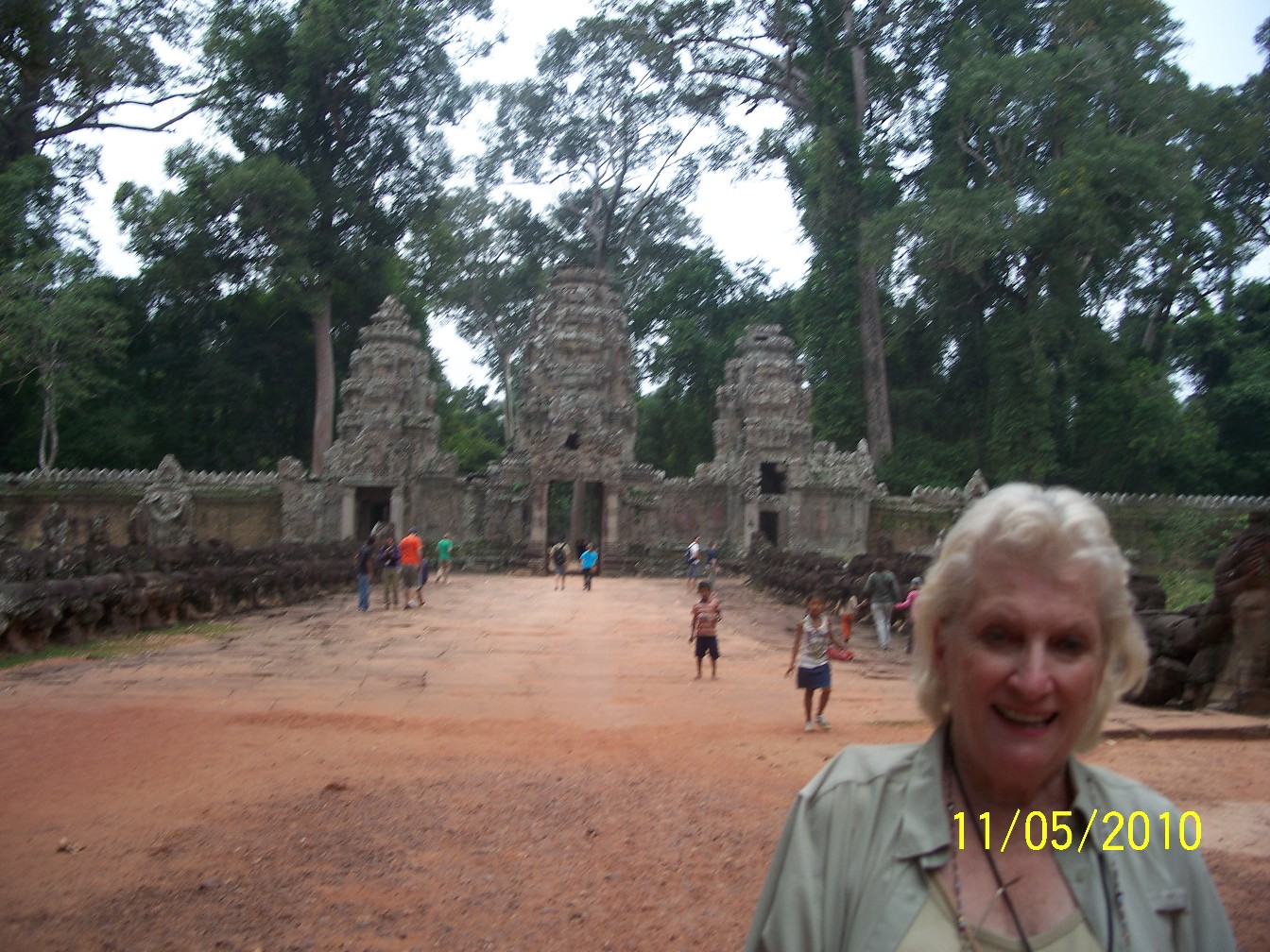
Grace and Ken at Angkor Wat

Long Hall with Bas Reliefs on Inside Wall

Bas Reliefs on Inside Wall
The Bas Reliefs are where the Cambodians come and make rubbings on paper to make a very beautiful artistic "painting".

The Angkor Wat complex has many sides and long walls. Below you can see the extent of a long hall. Inside the hall to the right is a long complete wall filled with bas relief sculptures.  These walls are on all sides of the Angkor Wat temple.  So many bas reliefs you cannot count them.
Our guide for out stay in Siem Reap
Cultural Dancer

Two Women in relief on the walls of the Angkor Wat Temple

That night we had dinner at Koulen II Restaurant and saw a Cultural Dance show. The buffet was extensive and crowded and the food average at best. The cultural show was good but it did not start until after dinner and we were so tired. The walking up and down Angkor Wat gave Ken leg cramps that night. The hotel was very nice except that the water pressure kept dying out when you took a shower.


Young Boys destined for monks in a pavilion next to the temple at Angkor Wat

Angkor Wat Early Morning on Friday

Salle Stemmons and Grace Early Friday

TA PROHM

The next temple we visited was Ta Prohm.  The main feature of Ta Prohm is the trees that have been growing there for many many years and they have taken over the temple.  There was much destruction of the temples from the trees.  This temple was built by Jayavarman VII in the late 12th and early 13th centuries.  Two types of trees are responsible for the destruction of Ta Prohm - the larger tree is the silk-cotton tree and the smaller is the strangler fig.  The trees that have grown intertwined among the ruins are especially responsible for Ta Prohm's atmosphere, and have prompted more writers to descriptive excess than any other feature of Angkor.
Grace surrounded by the tree roots at Ta Prohm
Ta Prohm

Ta Prohm wall figures

Ta Prohm

Ta Prohm

Tree Roots were everywhere at Ta Prohm
ANGKOR THOM - was built in the late 12th century by Jayavarman II and his successors.  One of the largest of all the Khmer cities and the capital until the 17th century.  The name means Great City.


Large Buddha at Angkor Thom
Tom Powell and Brett Chatelain thanking Tom's mother and step father for the trip around the world
Elephant Terrace at Angkor Thom

In the afternoon we visited 5 more temples – Pre Rup, East Mebon, Ta Som, Neak Pean and Preah Kahn. That made 8 temples in one day.

PRE RUP - was built in 961 under the reign of Rajendravarman

Apsara Dancers at Pre Rup
 

Grace and Salle at Pre Rup

 EAST MEBON - was built in 953 under the reign of Rajendravarman. This was used as a water supply as it held water all around the temple. It was originally capable of holding 55 million cubic meters of water. It is now dry.


East Mebon

Elephant at East Mebon
TA SOM was built in the late 12th and early 13th century by Jayavarman VII.  This small temple is like a miniature version of Ta Prohm and owes its charm to a combination of remoteness, semi-ruined state, and face-towers.
Grace at Ta Som

NEAK PEAN was built in the late 12th century by Jayavarman VII. It is a small monument in a cruciform arrangement of ponds with a sanctuary tower on a circular island in the middle.
Grace at Neak Pean
PREAH KAHN was finished in 1191 by Jayavarman VII.  This one one of Jayavarman VII's largest projects.  It was more than a temple with over 1,000 teachers it appears to have been a Buddhist university and a considerable city.

Grace at Preah Kahn

Salle Stemmons, Deena Behnke and Grace in Rickshaw on the way to the Hotel de la Paix for dinner

Sooo Good - Great Bread at the Hotel de la Paix


One of the dishes in the Special Gourmet Dinner at the Hotel de la Paix
The next morning we headed out to Tonle Sap Lake.  The lake is huge and goes for some 140 kilometers.  It is the home for fisherman and their families who live on the lake.  There are several water villages and many Vietnamese who came to avoid the various wars between Cambodia and Vietnam or other wars that have occurred over the years.


           Fishing Village on Tonle Sap Lake - one could easily feel like they are in South Louisiana


Area for entering and returning from the lake

While we were cruising on the lake there were several speed boats that pulled alongside and young girls would either jump on our boat which held 35 of us to sell us snacks and soft drinks or would have a python wrapped around their necks and ask for money to take their picture.


Snake Girl - note the Python around the little girl's neck


Family working in their home that morning

When we left Tonle Sap Lake we had lunch and then went to the Artisans d'Angkor in Siem Reap.  There the government sponsored a training center for crafts.  Older crafts people were teaching the younger generation their various crafts - painting, woodworking, lacquering, sculpting, gilding, etc.  We bought a gilded lacquer piece of the Apsara dancers.

We thought that Cambodia was the biggest surprise - so interesting and fun.  Grace hardly knew where Cambodia was and we were both surprised at how advanced the civilization was so many centuries ago.  A part of history we knew nothing about.  It was really overwhelming.

Next stop Hong Kong.

Sunday, November 14, 2010

VIETNAM

Vietnam and Cambodia


We arrived in Ho Chi Minh City (alias Saigon) on Wednesday, November 3rd early in the morning and made contact with Margot Richart. This is Kathryn DeMontluzin’s daughter who had offered to take us around. Actually, Margot had offered to take us around Wednesday and planned a dinner for Saturday night. Also, she offered to put us up in the family guest bedroom on Saturday night and take care of us on Sunday, which was our last day in Vietnam. We had already made plans to be in Cambodia to see the temples of Siem Reap including Angkor Wat. We had booked the trip that Margot had advised us to take after looking at all the various Cambodia trips a few months back. She picked the best one. That side trip took 3 days starting on Thursday and returning by 3:30 PM on Saturday. At least that is the hour shown as our return on the Green Sheet. The Green sheet is the last word on when and where the side trips are happening. Sadly the hour got changed to a return at 9:00 PM so we missed the Saturday dinner with Margot and Philippe and their friends. But we did have a wonderful lunch and visit with Margot, Philippe and their two children, Etienne and Eloise, on Sunday. You may notice from the pictures that the whole family is beautiful.

This entry is for Vietnam only and includes 2 days – November 3rd and November 7th. The three days in Cambodia will be the next entry.


Margo picked us up with her driver, Bau, at around noon at the Sheraton.

At lunch with Margo at the Temple Club


This was a very nice restaurant.


Square across form the Rex Hotel with the statue of some important Vietnamese person in front of a government building.


And interesting fountain in Saigon


 The Rex Hotel is where the shuttle from the ship took you into the city of Saigon.

We went to the War Remnants Museum. This is the museum that the Vietnam government has put up to show the horrors of the war and the war is referred to as the American War. Of course, the victors always write history so it only shows the awful atrocities that the Americans did. There is nothing that shows the atrocities of the North Vietnamese. Anyhow, we don’t seem to have taken any pictures inside the museum.  The devastation of the Agent Orange was really bad. Don’t know how the Vietnamese like us so much but they seem to anyway.


War Remnants Museum

Dinner at La Carmargue Restaurant
We had a wonderful dinner. 

Then on Sunday we went to the Richart's home.  Really attractive home and antiques.

Etienne at lunch

Grace and Philippe at lunch at the Richart’s


Etienne studying in his bedroom
 

Eloise in the living room
 

Good Bye

Cambodia next

Saturday, November 13, 2010

SINGAPORE

Early morning Sunday, October 31st we arrived in Singapore.


We called Todd Slater and met him in the Harbourfront at around 10:00 AM.

Grace and Todd meeting at the Harbourfront


We walked around the city and saw a number of sights.


Sculpture on the River

Ended at the Asian Civilizations Museum. It was great.

As a part of the exhibition in the Asian Civilizations museum there was a special exhibition on Sumatra. One of the featured areas was Nias. Nias is where St. Lazarus sent money and manpower to help rebuild the fishing fleet after the big tsunami several years ago.
Below is a picture of Ken alongside the beginning of the exhibit on Nias and the text that is in the information to Ken’s right.

Nias in the Sumatra Special Exhibition
Nias is an island off the west coast of Sumatra. The island can be divided into three regions – North, Central and South Nias. According to the people of Nias, they are able to trace their ancestry back 50 generations to the Gomo district of Central Nias. Traditional Nias society was an aristocratic one based on a strict hierarchy of nobles, commoners and slaves. Nias society was not anchored on a central governing authority but rather on a complex balance of power between groups of allied villages. The main power within a village resided in the hands of its village chief and his family because they counted themselves as the direct descendants of the village founder.

The traditional religion was largely based on ancestor worship. Ancestor carvings in wood and stone were once common throughout Nias although few traditional artefacts remain today as a result of the world’s fascination with “Nias tribal art”. This fascination was a result of the unique material culture that largely evolved over a long period of time in isolation from the rest of Indonesia. Today, the dominant religion on Nias is Christianity.


Ken and Grace among the Sculpture near the East Asian Civilizations Museum
 There were young people in boat races on the river. We watched awhile and tried to guess which boat would win each race.


Boats racing on Halloween in Singapore

Ken and Grace in front of the Merlion

The Merlion is the symbol of Singapore and is made up of a mermaid and a lion. Bet you didn’t know that.

This is a three building hotel with a pool on top across the 3 buildings. There is also a casino in the complex. Wow!

Note that in Singapore if one is caught with some minimal amount or more of drugs there is an mandatory death penalty. Singapore does not have a drug problem.
In the afternoon we walked around some more.


Raffles Hotel - Seah Street Side
Above is a shot of the Raffles hotel on Seah Street. We took the picture there because on our voyage is Edgar Seah, a Lifelong Learner from Singapore, age 32, who quit his job with Merrill Lynch to travel his bucket list. A really great guy.


The bar in the Raffles hotel
The Raffles hotel is where the Singapore Sling, an alcoholic beverage was first made. Sir Stamford Raffles was Singapore's founder and a lot of Singapore was developed by him.

 Then we went to the Botanical Gardens. There is a special section with orchids.


Grace among the orchids

Grace and more orchids
And more

Another color


Ken was fascinated with this big stand of orchids

Grace and Todd at the Botanical Gardens
The orchids really were stunning and we have a lot more pictures. Todd was a great host. Thanks, Todd

We were late getting back to the ship and had to go directly on the bus to the Night Safari. It was Halloween and the kids were out en masse. So many kids dressed in costumes plus scary werewolves and draculas along the path we took to see the animals. We saw a lot of animals in their natural habitat. It was too dark for our cameras but very interesting. It would have been better on a different night.


Several of our friends from the ship paid money to put their feet in a fish tank that was full of little fish that ate the dead skin off their feet and legs.
YUK!
The next day we just went into the mall and wandered around. We took no pictures in the mall as there was nothing that interesting. We restocked our Coca Colas for our frig on the MV Explorer.


Next Vietnam and Cambodia